Life in Fondwa

Saturday, August 26, 2006

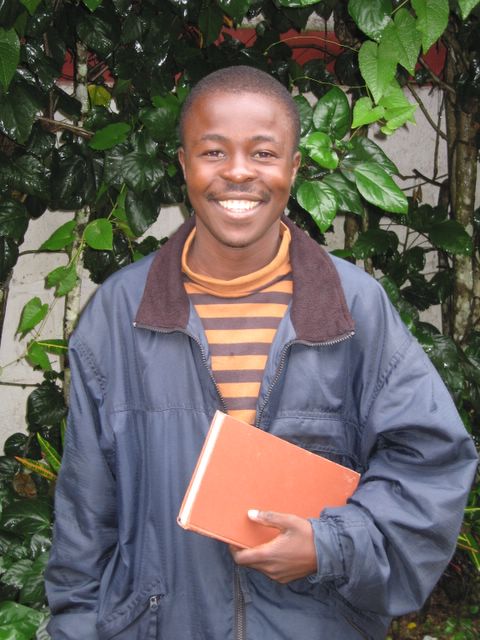
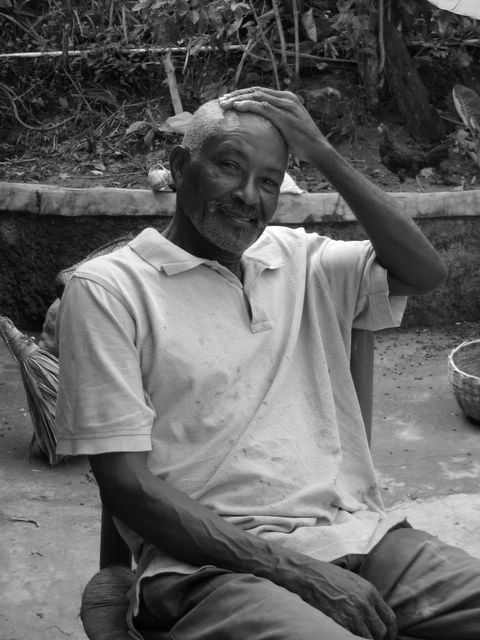
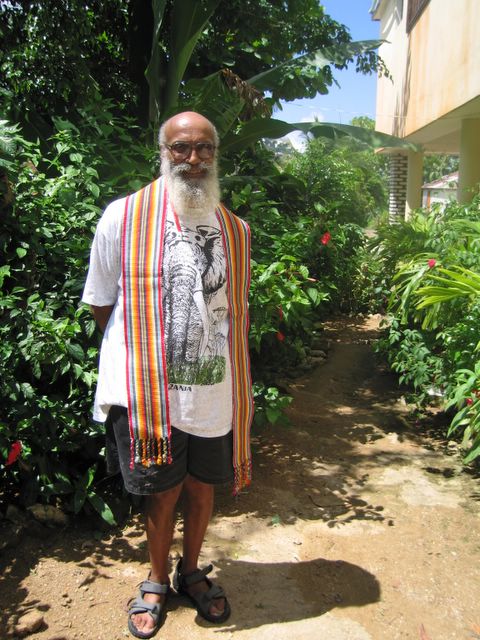
Fr. Albert McKnight Posted by Picasa

Tales of travel and teaching

Thursday, September 22, 2005


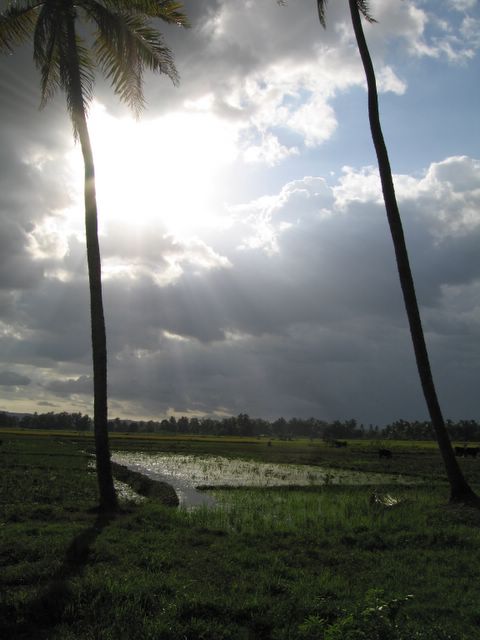
These past week or so has been eventful and productive. I spent last Tuesday and Wednesday in Port-au-Prince working with Fr. Joseph and the group that is arranging internships for our University students. On Tuesday I had a long afternoon session of troubleshooting and problem solving with Fr. Joseph at his home, which inevitably led to more work to be done in Fondwa. Fr. McKnight, a 78 year-old Spiritan priest from the US who has decided to retire to Fondwa, arrived that day and had lunch with us. On Wednesday I worked at the APF office and visited SUCO, a Canadian NGO, with Anne and Laurent, a French couple who have lived in Fondwa for two years. The three of us caught an afternoon bus back to Fondwa; the 2-hour drive took about 4 due to ‘technical difficulties,’ but we were happy to be back in one piece. I spent the night at Anne and Laurent’s house in Tomb Gato, where I lived during my time here in 2003. While we were descending the mountain the next day, a powerful thunderstorm rushed across the valley and overtook us before we could reach the APF Center (see the photo above). We were fortunate enough to take refuge in a friend’s house along the road before the worst of the storm hit.

On Sunday I visited Léogane to promote a two-month English conversation class that I will be offering in October and November. During the course I will leave Fondwa Thursday and stay in Léogane through Saturday, teaching on Thursday and Friday afternoons and Saturday mornings. Wednesday I started classes at l’Ecole St. Antoine, the APF’s school in Fondwa. I’m teaching Wednesday and Thursday mornings, 7th grade and 9th grade. On the weekends I also have an hour-long conversation class with the novitiates I live with, and there is no shortage of people asking for more lessons. Once the University students start their internships in October, I will be visiting them with another professor to evaluate their work. At that time, my schedule will officially be chok-a-blok full.

For now, I find I have a fair amount of time to read, relax, and spend time with people. I have become particularly fond of Djet and Julie, a pair of 2 year-old orphans who are too young to live in the orphanage, so they live in the APF Center with one of the sisters. They are together 100% of the time, and know few words other than each others’ name. Djet is especially fond of having his picture taken. He knows I’m taking his picture when the initial flash on my camera goes off, so in each photo he is squealing with glee at the flash that went off a moment before. Julie is less fond of pictures, but is starting to pick up on my name and the fact that my lanky frame makes for an excellent jungle gym.

The coming week will bring many English lessons, a friend’s one-year marriage anniversary party, trips to Léogane and Port-au-Prince, a meeting with USAID, and an over-night stay with a group that does cultural diversity training.

Sr. Carmelle and Missy Posted by Picasa

A Community Celebration

Friday, September 30, 2005

Last week brought the 43rd birthday of Sr. Carmelle Voltaire, the director of the guest center where I live. She spent most of the week in a contemplative, near-brooding state that often accompanies the passing of another year, but her personality emerged in full form on the evening of her birthday party. She donned an impressive African gown for the event, which she had received as a gift in the United States. By nightfall the whole neighborhood had caught wind of the buzz that surrounds a celebration in Haiti. When fetching water, dealing with illness, and amassing the basic necessities of life take up so much of one’s time, celebration takes on a whole new meaning of release from the daily concerns of life. Simply put, Haitians know how to party.

Whereas dinner around here is usually a bit of oatmeal or some re-heated spaghetti, Sr. Carmelle’s birthday spread consisted of an impressive display of mounds of rice and beans, crispy fried chicken, deep-fried plantains with a spicy vegetable garnish, a colorful assortment of vegetables, sweet potatoes, Haitian-style french fries, and the deep-red sauce that goes with everything. The celebration was begun with a rousing rendition of Happy Birthday in French, English, Spanish, and a Creole-English mélange, along with a champagne toast led by Ciné, Fondwa’s elder statesman. I was a bit surprised at the champagne, what with being in rural Haiti and all, until I realized that one bottle split amongst 30 people makes it more of a symbolic gesture than anything else. After the toast there was a long prayer and tribute to Sr. Carmelle, who strikes a large figure in the community because of her role in the guest center, the health clinic she runs, and the religious order she takes co-responsibility for. A young man at the event who happened to have the same birthday as Sr. Carmelle then took the opportunity to thank everyone to coming to his party, “even if I didn’t have time to invite you,” to the delight of the crowd.

The evening was topped off with a delicious home-made birthday cake and the rare treat of Haiti’s best (and, as far as I know, only) beer, Prestige. I took my Prestige with a bit of Coke, as per the local custom. It sounds strange, but a concoction with carbonation, sugar, and alcohol makes for a great birthday beverage. The sisters each have their own approach to alcohol, with some modestly abstaining while others indulge in the temporary freedom provided by the party. One sister, Myrlande, went so far as to offer a beer to the guest center’s pair of resident 2 year-olds, Djet and Julie. They not only accepted, but insisted on finished it to the last drop. I couldn’t quite tell later in the evening if their stumbling was a result of the Prestige or their limited motor skills. My American sensibilities aside, perhaps it’s only fair that everyone, young and old, escape through celebration from time to time.

Missy with a new-born triplet. Posted by Picasa

Drive-Through Market

Friday, September 30, 2005

Last Sunday the sisters and I left Fondwa for a week-long retreat in Port-au-Prince. We rented our own tap-tap, not for the comfort but because we just had that much stuff. We stocked up the truck with enough food and clothing for the week, and on our way to the city we did the rest of our shopping in Haiti’s drive-through market.

In Haiti, 90% of people survive by selling something. There are two great challenges associated with this way of making a living: no one has the money to buy anything, and there is no place to sell either. What results is the Haitian open-air market, where most economic activity takes place. Almost everything is sold in very small quantities, because most Haitians live literally day-to-day. Water is sold in small plastic bags for 2 Gourdes (US$1=43 HT Gourdes); Magi, cubes of seasoning used to make chicken broth, come in packs of 5, but are sold individually for 1 Gourde; you can buy one piece of chalk from a pack, or even half. Day by day.

The marketplace is also mobile. As we drove through Port-au-Prince, we did our shopping during the hour-long traffic jam we found ourselves in. A call to the side of the road brought a selection of buttons to the back of the tap-tap for our perusal. When stopping for gas, we picked up some friend plantains and fried pig fat (well, the others did). A larger purchase was a bag of “America’s finest super-fancy long grain rice,” which dominates the rice market here because Haitian production is so low and uncompetitive. Some sugarcane helped pass the time. Some new headphones replaced a broken pair. A newspaper filled me in on the country’s latest political developments. All without stepping foot in the market.

Our final purchase was a bag to put all of our other purchases in, naturally. Sr. Simone saw an older woman selling bags by the side of the road and called out “Pssssst,” the Haitian version of ‘hey you!’ Belying her advanced age, the woman took off on a sprint, avoiding other cars and the garbage in the street in her bare feet, and nimbly hopped aboard our truck. Sr. Simone referred to her as “my aunt” as they began to barter, the preferred means of exchange for most all transactions. As the bartering heated up, Sr. Simone changed to calling her “dear,” until finally she arrived at her final price and said “take it or leave it lady.” The sisters may be gentle souls, but they’re not about to get taken in Haiti’s drive-through market.

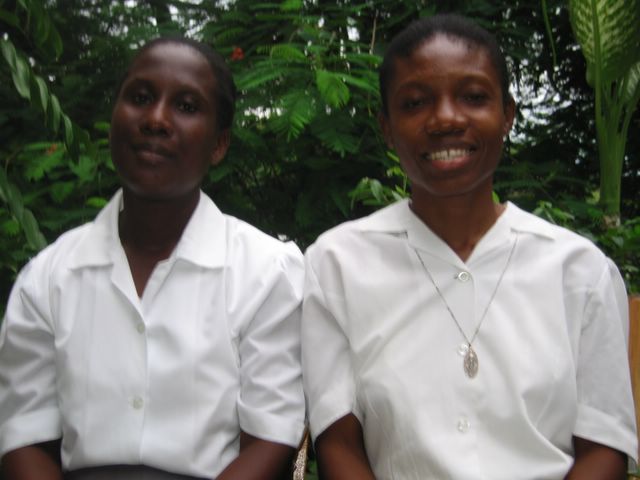
Claudette and Melicia. Posted by Picasa

Retreat in Port-au-Prince

Friday, September 30, 2005

I have spent this whole week in Port-au-Prince with Sr. Carmelle and Sr. Simone, who together are responsible for the Sisters of St. Anthony of Fondwa, and Claudette and Melicia, two novices who will make their preliminary vows on October 4th.

I have been translating for Fr. McKnight, an African-American Spiritan priest from Brooklyn who is leading them on retreat. Fr. McKnight arrived in Haiti just two weeks ago, after deciding to retire to Fondwa at the tender age of 78 years old. He may be getting up there, but his spiritual energy is electrifying, and his sermons on the relationship between the spiritual and material world, the need to know yourself, and even the spiritual consequences of quantum physics are always engaging.

Translating personal reflections has been no problem, but putting the wisdom of esteemed theologian Ronald Neibuhr or the philosophical insights of scientist Max Plank into Creole (on the spot no less) has my head spinning. At least I know that after spending a week with these deeply spiritual people I can’t help but have a bit of positive energy rub off on me.

Hey, that smells almost like...

Wednesday, October 05, 2005

On Saturday I accompanied Missy, the other American volunteer in Fondwa, to Jacmel, where she had some mail to pick up. Jacmel is a cozy town by the sea with some impressive colonial-era architecture, a thriving arts scene, and many beautiful beaches. I usually have a relaxing and enjoyable experience when I go to Jacmel; this time, I got more than I bargained for.

After trekking up the mountain to Anbatwanel, Missy and I climbed aboard an already fully-loaded bus heading for the Southern coast. A warm day becomes even warmer when there are that many bodies stacked on top of each other, and the bus was by no means immune to day’s hot sun. When a group of young men started running after the bus flailing their arms, the driver caught on that something was wrong. As he pulled over to the side of the road, an all-consuming pungent smell enveloped the bus; it smelled almost like… burning tires. The bus’s left rear tire was in flames, and there was a stampede to escape out the back door. I managed to get out by flowing with the tide of frightened passengers.

The driver stepped down to take in the situation, and determined that the wheel wasn’t doing so bad. After all, it was now only smoking, not flaming. He decided to give it a go, and there was another stampede to get back on the bus as it started to move again. Not being Haitian, I didn’t have the killer instinct necessary to force my way through the crowd of people amassed at the back entrance; even though there was room enough for everyone in the bus, people were staying near the exit in case of another emergency. The bus picked up speed, and I ran after it day pack and all, finally managing to jump on the back bumper and cling to the roof for dear life. It wasn’t so inconvenient in the end, because, predictably, the tire started burning just a bit down the road. Missy and I decided to walk to rest of the way, convinced by the second burst of flames that staying with the bus was not going to lead to a relaxing and enjoyable experience.

Friends Danny Richter and Eliber walking by the beach in 2003. Posted by Picasa

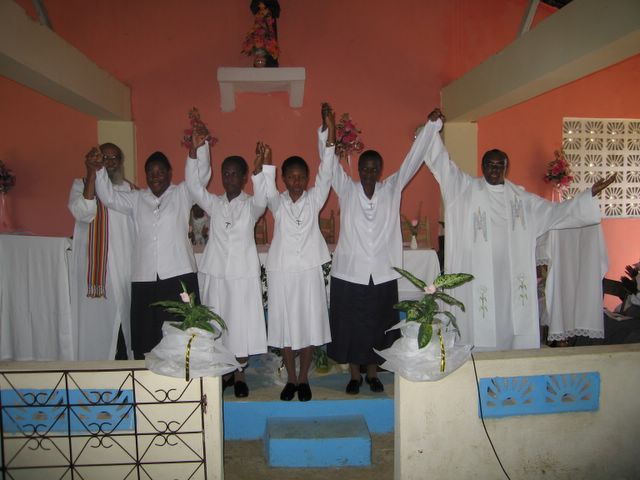
The new members of the Sisters of St. Anthony of Fondwa. Posted by Picasa

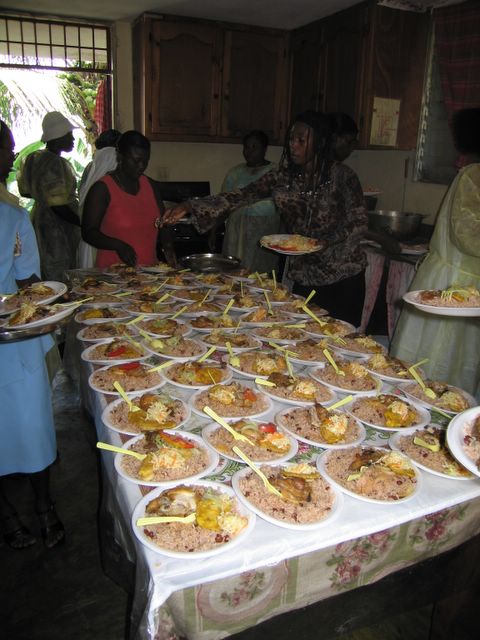
What a spread! Posted by Picasa

Fr. Joseph and Fr. McKnight. Posted by Picasa

The meaning of homemade

Wednesday, October 05, 2005

Tuesday brought an occasion that the Sisters have been looking forward to for months. Sister Melicia and Sister Claudette took their temporary vows, the first two novices to do so in the newly-founded Sisters of St. Anthony of Fondwa. It has been nine years since Fr. Joseph founded the congregation, and after a few false starts the community finally has its first full members.

The ceremony took place in the St. Anthony Church, 10 minutes down the road from the APF Center. Guests came from all over Haiti, including a number of sisters, brothers, priests, and foreign missionaries. All told there were about 300 participants, all converging on the tiny village of Fondwa in the remote mountain valley two hours south of Port-au-Prince.

Though they don’t have many material resources, the Sisters pulled out all the stops for this grand occasion. The church was beautifully decorated with flowers and ribbons, and six older gentlemen sported colorful hand-crafted “Welcome” signs to greet the invitees. The greatest production was the reception that followed, during which 300 people were served a full meal of beans and rice, turkey, goat, fried plantains, eggplant à la Française, salad, french fries, and popcorn. The popcorn seemed a bit out of place to me, but it’s a sort of delicacy because they prepare it so rarely. Another small touch was yellow mustard, which didn’t really go with anything but made the event just a bit more fancy. Everything, and I mean everything, came down to the last minute (in true Haitian style), but somehow it all came together and everyone seemed to enjoy the feast.

The whole ordeal was capped off by not one but four impressive cakes. In the two days that I observed the baking of these cakes (that’s right, a full two days), I came to a new understanding of the term ‘homemade.’ The process included hours of beating the butter, sugar, milk, eggs, flower, and rum in a large tub with a flat stick, then cooking each cake one-by-one in a small oven, and finally decorating them elegantly with an improvised icing. After participating for just a few minutes in the beating stage, I have half a mind to write Betty Crocker about how she mislabels her products as homemade. I now know that homemade means that you hurt after you bake it, and the only remedy is the sweet taste of the final product. And oh, how sweet it was.

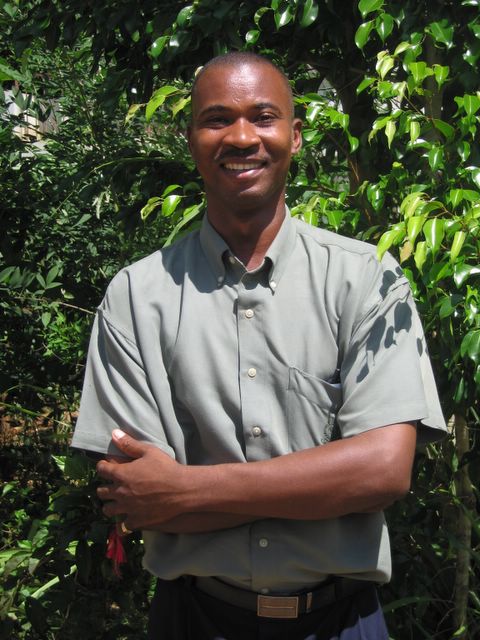
Herault Beauvais Posted by Picasa

Hérault Beauvais

Thursday, October 06, 2005

Hérault Beauvais, a native of Fondwa, serves as the APF’s Fondwa-Port-au-Prince liaison. He was born 33 years ago in his family’s humble dirt floor home, the youngest of three children. After completing his primary school in Fondwa, Hérault went to Port-au-Prince for secondary school, beginning a long voyage of education, training, and work that continues to this day.

During his secondary studies he sought to augment his education with practical training through two-year courses of study in auto mechanics and men’s apparel. After receiving his high school degree, he undertook two years of study in accounting. He then had the chance to participate in an exchange program in Roanne, France, where he studied accounting and management for one year. After returning to Fondwa in 1997, Hérault started working with Radio Zetwal, the local radio station. By 1999, he was the director of the station. He began his current work as APF liaison in 2001, and has also been active in managing the APF’s small businesses, especially the bakery. While working full time, he continues to seek to improve his education; he recently began the second year of a four-year program at Port-au-Prince’s Superior Institute for Administration and Management.

Hérault has been involved with the University of Fondwa since its formative stages, and now sits on its Administrative Counsel. He thinks that “the work we are doing here in Fondwa can’t be limited to our community. The University holds the key to the dreams of the APF for all of Haiti.” Though he acknowledges that UNIF faces many challenges, he accentuates the many positive aspects of the project. The academic level is of very high quality, and the students have the distinct advantage of learning about rural problems in a rural setting. He also notes that the University has a solid team of professors and administrators, and believes that “UNIF will be a tool for much-needed decentralization in Haiti, so that people can organize and develop their own communities.”

Amenold Pierre Posted by Picasa

Aménold Pierre

Friday, October 07, 2005

Aménold Pierre, 29 years old, is from La Vallée Jacmel, near the Southern coast of Haiti. His parents, both peasant farmers, never had the chance to learn how to read and write, making his path to become UNIF Professor of Agronomy all the more remarkable.

After completing his primary studies in La Vallée, he went to Port-au-Prince for secondary school. With the help of a priest from his hometown and the support of an older brother, he was able to go to Panama to pursue a university education in Agronomy. He arrived March 4th 1998 speaking very little Spanish, and started courses just 11 days later. “It was very had at first,” he remarks, “but I learned how to read well and spent all of my time in the library.”

Upon graduating in 2003, he returned to Haiti and was informed about UNIF by a childhood friend. He started by teaching courses on Thursdays and Fridays, working in Port-au-Prince the rest of the week. His dedication to his students is admirable; he once got stuck in Léogane on the way to Fondwa, sleeping overnight in a broken-down truck before finding a ride in time for class the next morning.

Amenold has big plans for UNIF and his home community of La Vallée. He currently has a weekly radio program called ‘An Evening of Agriculture,’ and is the General Director of an organization called ‘Movement for the Economic Recovery of La Vallée.’ His professional interest is the business aspect of agriculture; he has already started a technical school in La Vallée, and would eventually like to do a Masters in Environmental Management. Of UNIF, he says that it can be a model of sustainable economic development both for Haiti and other poor countries. “If UNIF fulfills its promise,” he says, “I will feel proud to know I have been a part of its development.”

Tying the knot

Wednesday, October 12, 2005

Last week Anne and Laurent, a French couple that has been working in Fondwa for two years, were married in the French Embassy in Port-au-Prince. Some people might find it odd to marry without their friends and family just two weeks before returning home. To those doubters, Fr. Joseph responds: "It must be Haiti!"


The day after the wedding, they invited many of their friends to celebrate the occasion with a party on the beach in Jacmel. They rented a yellow school bus to pick everyone up, and we all went together. There was plenty of food, drink, and dancing, enough to last through the night. I ended up strewn across four chairs by the time everything wrapped up at 5 in the morning, but the more adventurous souls kept the party going. Below are a few photos that capture the eclectic nature of the evening. I guess there's nothing quite like tying the knot in Haiti.

Breaking down cultural barriers with musical chairs. Posted by Picasa

Mano singing a rousing rendition of Guantanamera. Posted by Picasa

Herault enjoying the evening. Posted by Picasa

Manouche Douze

Tuesday, October 18, 2005

Manouche Douze is one of UNIF’s four students from Mirebalais, in Haiti’s Central Plateau area. Her home is in a small town named Gran Boucan, where she lives with her mother and father, both farmers, and her 5 younger siblings. During her classical studies, Manouche was the treasurer of her church’s Director’s Committee, and she speaks of religion as an important part of the UNIF experience. Though the students of UNIF, which does not have an official religious affiliation, come from different religious backgrounds, they all participate in Fondwa’s spiritual life. For Manouche, who stays in a UNIF residence with the other 9 female students, “religion is an important component of learning how to live with each other.”

The residents of Gran Boucan have a number of challenges to confront together as well. Manouche describes the area as greatly lacking in infrastructure, schools, and health care. Simple necessities such as latrines and potable water remain all too elusive. “Still,” she says, “it’s where I come from, and I want to participate in its development.” Toward that end, Manouche brought together 40 members of her community in 2004 to found APGN, the Peasant Association of Gran Boucan. Founding the organization is just one step in her efforts to improve the conditions of her hometown that will continue after she receives her degree in Agronomy from UNIF.

Manouche appreciates the professional skills she is learning at UNIF, with practical work and studying in 4 languages complementing her normal course of study. As to where she will put those skills into use, she says “I come from a rural area, and I can’t ignore that in Haiti, peasants are the most unrepresented people. It shouldn’t be like that.” She thinks that having a university in the mountains is a positive way of changing the relationship between peasant farmers and college graduates. “As we interact with the residents of Fondwa, students come to have a new vision of their work, and the peasants see that there are people who are concerned about rural issues.” It is evident that Manouche knows where she comes from and where she would like to go: “I’m a child of peasants, and it’s my mission to work with them.” With a full scholarship from Fonkoze Director Anne Hastings, Manouche will be able to pursue her mission with the help of an UNIF education.

Manouche Douze Posted by Picasa

Charles Edner Posted by Picasa

Charles Edner

Wednesday, October 19, 2005

As the son of peasant farmers from the Northern town of Borgne, Haiti, Charles Edner made a long journey to join UNIF 2004’s founding class. First, he beat the long odds of pursuing higher education, an even greater challenge for students from rural areas. Second, he made the more than 300km trip from his hometown to Fondwa (over two days), traversing mountains, valleys, and rivers on the nearly impassable roads.

Education is always a sacrifice in Haiti, and nowhere is that more evident than in Fondwa. “No one else is taking this initiative,” says Charles of UNIF, Haiti’s first rural university. His educational experience is the result of many people sacrificing for a common cause. Though the students come from all over the country, “we have adapted well to one another,” Charles says. “We also have a very close relationship with our professors, and we are very satisfied with our courses. The education we receive here will help us solve the problems in our communities.”

Because of his rural upbringing, Charles finds that he has a close relationship with other peasants, which is essential for his studies in Agronomy. Thanks to UNIF’s rural setting, “we have more contact with farmers and their work. When you go to Port-au-Prince, you are disconnected from the reality of rural Haiti.” This semester, Charles is doing an internship in Limonade, in the northwest, with Vétérimed, “a very well-known NGO in Haiti,” as he notes. He looks forward to the internship as an experience that will improve his professional skills as a future Agronomist. All part of the UNIF education.

Reinforcements

Thursday, October 20, 2005

This week Fondwa welcomes another 'koperan' (foreign worker), my friend Dan Schnorr. Dan graduated from Notre Dame with me in May as a Pre-Med and Philosophy major, minoring in travel, peace, and rabble-rousing. He subsequently became an official employee of the Federal Government as a firefighter in rural Nevada. Hopefully he won't have any need for his new-found skills in Fondwa, but it was probably good training for the rough-and-tumble life of rural Haiti.

When he arrived on Saturday, Dan had a typically Haitian introduction to his new surroundings. American Airlines managed to lose his luggage between
Boston and PAP, forcing us to survive for three days on my day (note: singular) pack. We were more than relieved to go pick his bags up at the airport on Monday.

The picture above is from Dan's first experience of our working conditions in the
APF Center. As you can see, he is adapting just fine. Nou oblije (we're obliged). He is very talented and a quick learner, so I'm sure he will soon be making a big difference in the work of the APF.

Being resourceful. Posted by Picasa

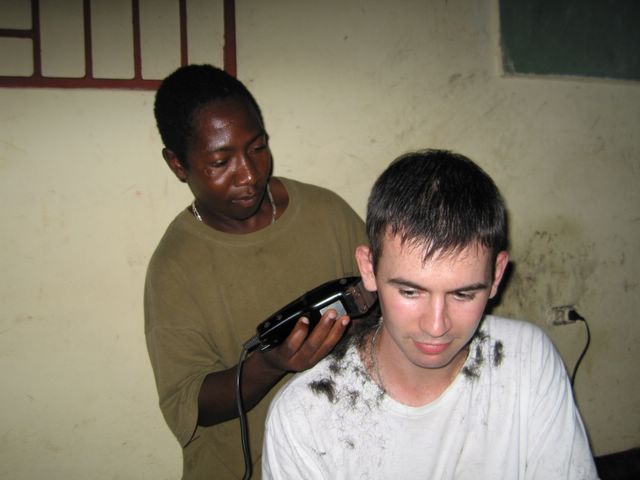
Yves clipping away. Posted by Picasa

The Fondwa Barbershop

Saturday, October 22, 2005

Above is a photo of Fondwa's barbershop, which is located wherever Yves can plug in his clippers. There isn't much competition around these parts, because most people simply take a naked blade from a razor and start scraping. As hesitant as I was to let Yves experiment on his only white client, I wasn't about to put my life in the hands of a stranger with a Bick. With some minor post-haircut adjustments, I think it turned out just fine. And not a single life-threatening injury to boot.

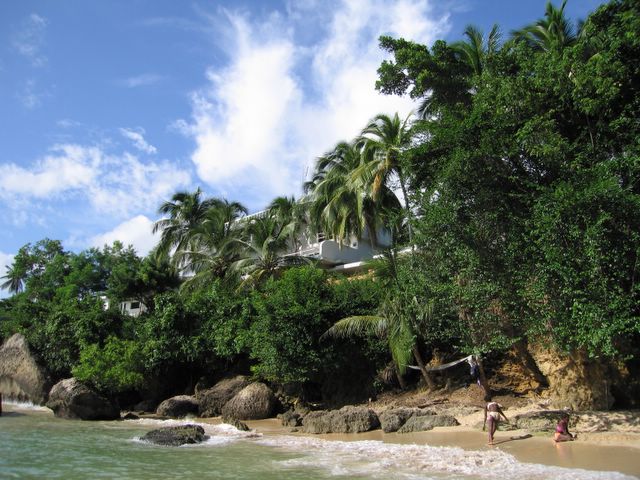
Fun in the sun. Posted by Picasa

Destination: Paradise

Sunday, October 23, 2005

If you can't see it, there is a tropical paradise hidden in the lush vegetation featured above. Missy, Dan and I went to a place called Cyvadier Plage on Saturday, a destination that includes a top-notch restaurant, hotel rooms (for those hoards of tourists in Haiti right now), and a cove that holds strikingly blue water and white beaches.

In Dan's one week here, he has experienced the heat and squalor of Port-au-Prince, the scenic (yet difficult) 2-hour drive to Fondwa, life in the mountains, and the best of Haitian tourism. And we're just getting started.

What Role for Women in our Communities?

Sunday, October 23, 2005

A reflection from UNIF’s female students

It is clear that women play a central role in our communities. Looking back at Haiti’s past, we see that women have often been limited by their lack of opportunity in terms of education. As a result of this limitation, men have come to play a dominant role in our society in certain domains, especially in business and politics.

Today, we are experiencing a change in the place of women in Haitian society. As we see with the current elections, it is possible for women to run competitively in political races. As is evident from the number of women in UNIF’s founding class, it is possible for women to go to university and work for the future of this country. Rather than accepting the lot of their communities, Haitian women are forming associations to transform them. In recognition of the perils of a society in transition, women come together to protect the rights of other women. Women can become presidents of organizations, managers of businesses, and leaders of communities.

Photo of Ebelle Jeune by Rebecca Sherman. Posted by Picasa

A true piece of Fondwa history

Wednesday, November 09, 2005

Last week I was introduced to a genuine piece of Fondwa history. Early Friday morning I set out on a trek along with Eugenio, Danny, and Missy that eventually took us down to the depths of the Fondwa valley, across a river at two points, and up the slippery slope of the mountain on the other side. Our destination was the house of Minik Nocent, the first President of the Peasant Association of Fondwa (APF), which founded the university I work for.

Minik was born in Fondwa in 1934, the last year of the 19-year American occupation of Haiti, at a time when the area was much more productive. He recalls his parents planting crops that farmers don’t even try to produce anymore because of the degradation of the soil they cultivate. He comes from a family of nine children, with some in Fondwa, some in the United States, and some who have returned to Guinea (which symbolizes Africa, the Voodoo version of heaven). When Fr. Joseph Philippe, who had gone to Cananda and the United States to finish his theological studies, returned to Fondwa in 1988, Minik was amongst the group of nine leaders that he called together to consider their common problems.

The group, which included two of Minik’s children as well, decided to form an association, which the called the Asosyasyon Peyizan Fondwa. Their first move was to construct a small building for meetings with a bit of money that they each put into a common fund. All they could afford was wooden poles and coconut leaves, but as they say in Creole, “A house of leaves can’t block the rain, but at least it can block the sun.”

After that, the 9-member committee decided that if there was no road to Fondwa, there would never be development. The still didn’t have money, but the residents of the region came out in force to participate in a project that responded to their needs. Nine groups of twenty people each began work on the road, which was built with picks and hard labor. Today part of the road had been paved with help of the Inter-American Development Bank, and it serves as Fondwa’s access point to the major highway that crosses the mountain above.

The APF soon began working on the most pressing issues facing Fondwa peasants, such as tapping water sources, reforestation projects, and providing agricultural formation. They looked abroad for help from the beginning, working with international NGOs that had Haiti branches and a French NGO called CEIPAL that provided extensive help to buy a truck. While there was much work to be done, not everything went exactly at planned.

Minik’s son Ismit, also a former President of the APF, participated in a prayer group around the time of the APF’s founding. The group wanted to get involved in the development work that was going on, so they put 15 gourdes together and thought about what kind of a project they carry out. They decided to buy tobacco in bulk and sell it in small sacks, so they chose a ti machann (market woman) to sell the tobacco at market. They counted on doubling their money, but hadn’t counted on the ti machann’s husband smoking all of the tobacco. It took months to get the money back, but when they finally did a new ti machann was able to make 45 gourdes.

One of the group members took the money to buy soap, again ostensibly to sell at market. She ended up using it to do her washing, and the group was only able to get 25 gourdes back. The other members, refusing to be discouraged, continued to put money into a common fund and approached Fr. Joseph for help. He helped them find 500 Haitian dollars (2,500 gourdes) to begin a real cooperative, which today has 200 clients and has offered nearly 700,000 gourdes worth of credit this year. The path isn’t always straight and narrow in Fondwa, but that’s only because we have to build it with picks and hard labor.

Minik Nocent, first president of the APF Posted by Picasa

Funny, but wrong

Wednesday, November 09, 2005

I recently gave a test to my 7th and 9th grade English classes. Most of the kids passed, either because of my superior teaching skills or because I just didn’t have the heart to fail them. Here are some of my favorite responses:

When is your brother’s birthday?

- My brother’s birthday is the 12th in 1890

Translate the following question: Ki jan ou santi ko ou? (The answer is ‘How is your heath?)

- Where is your body?

What do you think about deforestation?

- It makes me happy

What should people wear during the summer in Haiti?

- An umbrella

I have finished teaching in the school, because next week I will begin visiting UNIF students where they are doing internships. I’m happy because I get to see most of the country, but my students were a bit upset: “you make me cry!”

It takes all sorts


Wednesday, November 09, 2005

Dan and I took another trip to Léogane on Friday to accompany Missy as she checked her mail. We waited along the highway for 2 hours, but all of the buses that came by were chock-a-block full. A nice SUV with some white people inside drove by, so I flagged it down to try my luck. They agreed to give us a ‘wou lib,’ or free ride.

I have gotten rides to Jacmel in private cars three times now, and each has been a unique experience. The first time was with a doctor who worked with a nursing school that has campuses throughout Haiti. We talked about the similarities between UNIF and his school, and he even gave me a tour of the Jacmel campus before dropping me off. The second time someone stopped I hurried through the usual sob story of not being able to find a bus in my accented Creole, and the middle-aged woman in the passenger seat replied “Honey, do you speak English?” It turned out that she was a double US-Haitian citizen who had lived in Miami for 30 years, and had recently moved back to Haiti. When I remarked what a beautiful country Haiti is, referring to the impressive scenery as we were driving through the mountains, she said “It’s great, we don’t have to pay any taxes!”

The last time was even more interesting, because we were picked up by a pair of missionaries, one from Iowa and the other from the Caribbean island of St. Vincent. They were part of a small community of missionaries that has no name, no fundraising efforts, and no organization. Still, they were driving a new SUV and one had just been back from a 5-month series of conferences in Europe, so something seemed a bit off. In any case, the Iowan had been in the country for 23 years, making him a veteran of a dictatorship, transition to democracy, two military coups, and the current internationally-appointed regime. We have been invited to their house for coffee anytime, and I just might take them up on it. It would surely make for good conversation.

Students come to campus

Wednesday, November 09, 2005

The students came to campus October 10th-14th to prepare for the internship period, which goes from October 17th through mid-February. It was my first opportunity to meet most of the students, which was a great pleasure. They are a very close-knit group, which would tend to happen in a university with only 20 students. During the course of the week we went over the internship requirements, had a few lectures to help them with specific tasks, and met with Fr. McKnight, UNIF’s spiritual director. It was my job to translate, because Fr. McKnight, who is from Brooklyn, doesn’t speak much Creole yet, and the students, though quite fluent in French and Spanish, aren’t very strong in English. Hopefully that will change next semester!

I also had the chance to interview many of the students and take their photos; the biographies and articles that I wrote can be found on UNIF’s website, www.unif2004.org.

Thursday, August 24, 2006

The Challenges of Today Become the Progress of Tomorrow

Thursday, November 10, 2005

(From the Bloomington Sun Current)

I decided to spend my first year out of college in Haiti for many reasons, such as immersing myself in another culture and growing as an individual. Beyond those personal concerns, though, I also had a job to do, working as the Secretary of the University of Fondwa. I have quickly come to see that the two are closely related, each not possible without the other.

There has been no shortage of obstacles to achieving my goals. Communications can be difficult because the cell phone network doesn’t reach our valley, a lack of electricity prohibits internet access through even the most advanced satellite technology, and the nearest post office is two hours and a large headache away. The Haitian custom of warmly greeting each person you encounter at the office is much appreciated, but it can be a burden when there is much work to be done. Even seemingly unrelated problems can be a hindrance; it is tough to work well when there isn’t any water to bathe with, or when hunger sets in because rice and beans have been served for the 83rd consecutive day (and counting).

Mother Nature has her own unique role to play in this game. When tropical storm-force rains hit Haiti last week, the road to Port-au-Prince was blocked by impassable bridges. When I had to travel to the city for work, what is normally a two-hour trip became a four-hour marathon.

As daunting as these challenges may be, they pale in the face of the daily struggles of the peasants of Fondwa. My work hardly compares to their own, toiling under the hot Caribbean sun to produce the rice, beans, and vegetables that are their lifeblood. The weather is often an inconvenience for me, but it is a matter of survival for them.

The Peasant Association of Fondwa (APF), which founded the university I work for, was created in 1988 by local farmers to take on these challenges together. It seems that what allows the members to overcome the myriad difficulties they face is the fact that they have a common goal, the goal of promoting the well-being of the community.

What continues to impress me is the relentlessness with which they pursue that goal, regardless of the numerous difficulties that lie before them. With each milestone that is reached through the efforts of the APF, like the construction of the local school and orphanage, planting of trees, and planning of model farms, the solidarity of the group increases. The more they accomplish as a group, the greater their capacity to work together becomes.

In the same way, I have found that my personal challenges have been a necessary stepping-stone to completing the work that I have been given to do. Without them, I would have no basis for understanding the problems of the people I have come to live with. If it were easy to build a university in the mountains of Haiti, one would already have been built. After two months of blackouts, rice and beans, and periodic flooding of major highways, I think I will be hard pressed to find something I can’t handle. The lives of the peasants of Fondwa won’t be transformed overnight, and neither will I accomplish all that I have set out to do, but the challenges we face today will help us progress tomorrow.

Dancing. With vigor.

Tuesday, November 22, 2005

Each time I set out on a trip in public transportation, I think I know what I’m getting myself into. I am always mistaken. On Wednesday I went to the station where buses leave for the South with Vital, a professor of Agronomy with UNIF. We found a bus for Aux Cayes, where two students are doing internships, and I settled into a seemingly benign seat near the front of the bus. My seat became infinitely smaller a moment later when a grandmother of generous proportions took up residence beside me. It may not have been so bad, but it just so happened that she was in the dancing mood. As the bus pulled out of the station and the same Kompa music that plays in all buses started blaring from the front speakers, granny started moving to the beat. With vigor.

When we finally arrived at Aux Cayes many, many hours later, I was ready for a break. Vital had a place to stay with a friend, but there wasn’t room for two so I had to find a hotel. The hotel manager instantly recognized the potential for a large payday, asking the foreigner for 100 Haitian dollars (about $25US) per night. I later did some investigating and found the real price to be about one-fifth that price, and some intense negotiating led to a significant discount from the blan rate.

Aux Cayes is Haiti’s fourth-largest city, situated on the Southern coast of Haiti’s Southern peninsula. The difference between Aux Cayes and Fondwa can be summed up in one word: WATER. Aux Cayes has it, Fondwa doesn’t. As I traveled through the surrounding area, including Port Salut, the tiny town where Jean-Bertrand Aristide was born, I saw endless fields of rice and other crops that thrive on the lush, flat plains of the region. Vital was legitimately incensed that his government is not capable of fully taking advantage of such fertile fields; with more investment in basic infrastructure, he thinks that Aux Cayes could provide for much of the food needs of Southern Haiti.

Given the way things are in Haiti, we visited a project that shows what can be done even amongst the current political and economic turmoil. Chouloute Jerome, a 35 year-old Catholic Brother who decided to go back to school to study agronomy at UNIF, is doing his semester-long internship with AVSI, an Italian NGO. Vital and I surprised him with an on-site visit, for which we left Aux Cayes on a small (yet disproportionately dangerous) motorcycle and then trekked through the countryside to find him working on a tree nursery. The program he is interning with targets area residents who are at risk of malnutrition; rather than simply providing food, it works with them to plant their own gardens and gives on-going formation in agricultural techniques.

Vital, who was doing an evaluation of the internship for UNIF, remarked that Chouloute was getting practical experience in subjects that usually aren’t studied until the 5th year of university. What I took away from the visit was the fact that Chouloute is willing to live away from home, make a long voyage each day, and work in a poor rural setting during an unpaid internship. Haiti has no lack of political candidates (there are some 40 candidates for Fondwa’s one local seat!), but there are only so many university students and graduates who are willing to work in the areas with the greatest needs. UNIF graduates promise to return to their home communities to work on rural development projects after they receive their degree, and they are keeping that promise during their internships this semester.

At 3:06 PM, Cheryll said…

Thanks for the colorful travelog!

Two things I found very hopeful in your report (which things, of course, are never mentioned in US media):

- that Haiti has agronomic potential to feed its people
- that even more important, it has people who are altruistic and actually making a difference

Always like to find out this sort of affirmations!

Water! Posted by Picasa

La Citadelle. Impressive. Posted by Picasa

Cap Haitian, a City of History

Tuesday, November 29, 2005

This past weekend I had the opportunity to visit Cap Haitian, located on the Northern coast of Haiti, an historic city for both Haiti and the world. In 1492, Christopher Columbus landed near Cap Haitian and established the first colonial settlement in the Americas. He found a land populated with native Taino and Arawak peoples, who numbered from one to several million. Just a few decades later, slavery, war, and disease had nearly obliterated the population. One of the only lasting remnants of Haiti’s native peoples is the country’s name; after gaining independence, the former colony of Saint Domingue was renamed after the Taino word for ‘mountainous land,’ Ayiti.

It was in 1670 that Cap Francois (as it was then known) became the administrative center of the French-controlled part of Hispaniola. As Saint Domingue grew into the most productive colony of the 18th century, providing much of Europe with sugar and cocoa, Cap Francois became known as the “Paris of the Antilles.” In Haitian history, the area is most significant as the site of the Vodou ceremony in 1791 that launched the Haitian revolution. In a clearing called Bois Caiman, slave leader Boukman called upon the Vodou lwa (spirits) and his fellow slaves alike to rise up against colonial oppression. Thirteen years later at Vertières, also in the North, General Jean-Jacques Dessalines fought the last great battle of the Haitian Revolution, finally repelling Napoleon’s forces for good.

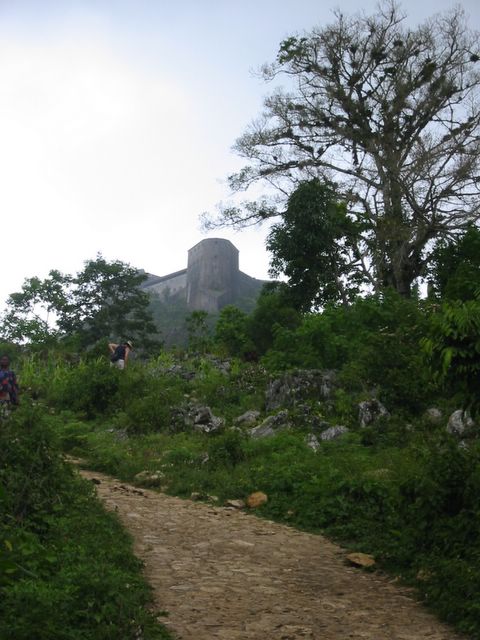
Dessalines became the Emperor of Haiti in 1804, but he was killed just two years later. At that time the country was split in two, with General Alexendre Pétion ruling the South and General Henri Christophe taking over the North. Christophe rebuilt the re-named Cap Haitian, which became his capital, to some of its former glory. His most impressive achievements were his castle, the Palais Sans Souci, which is said to have rivaled Versailles in its day, and the behemoth Citadelle, a fort built with the labor of 20,000 men high atop a mountain to protect against a return of the French.

Sadly, today Cap Haitian is an over-crowded city with a crumbling infrastructure that the government shows no interest in improving. As is usually the case, it is up to the local peasants and non-governmental organizations to find a way to confront the problems of the area. One organization that is taking an innovative approach is Veterimed, a Haitian NGO founded in 1999 in the nearby town of Limonade. UNIF has two students doing internships there this semester (Moussanto Dantil and Charles Edner), working mostly with a program that gives seminars to peasant groups about how to care for their animals and increase production. Veterimed also runs a business called Let a go-go (A lot of milk) that buys milk from peasants and turns it into various products like bottled milk and yogurt. The program has gone nation-wide, and I can personally vouch for the great taste of their chocolate milk! Cap Haitian may not regain its former glory anytime soon, but providing a decent income for peasants and producing a nutritious product is a good place to start.

Haiti is a beautiful country. Period. Posted by Picasa

Kids hanging out near where we broke down. Posted by Picasa

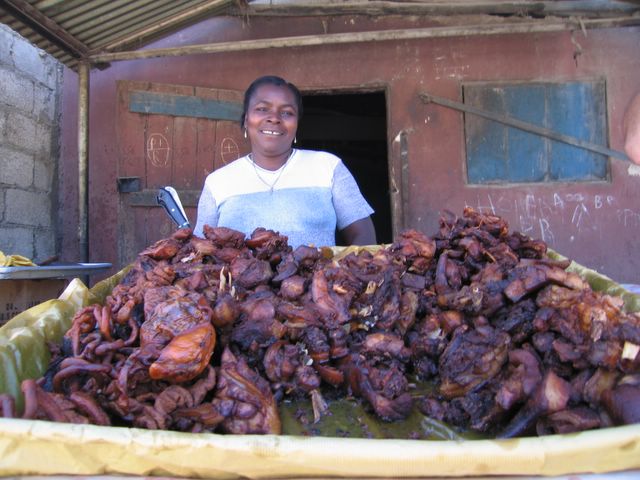
Fried pig guts. Yum! Posted by Picasa

The Rotary snack bar in Pignon. Posted by Picasa

Oh, How I am Blessed

Sunday, January 08, 2006

People are often surprised when they hear me talk about Haiti in a positive light. Yes, there are many things to like around here, which is one reason why Haiti was a popular tourist destination for a large part of the last century. Still, there are some things that just suck. Like transportation.

Getting to Haiti’s Central Plateau, where UNIF has several students doing internships, really shouldn’t be that hard. It’s about 30 minutes by plane and not even that mountainous by Haitian standards. Yet to get to the station that takes you there requires an hour and a half tap-tap trip to Croix-des-Bouquets. From there it’s anywhere from a 5-hour to an all-day trip; I caught the all-day truck. Me, Dan, Vital and Amenold arrived at the station at 7:30 in the morning, but then had to wait until after MIDDAY for the truck to fill up. After breaking down twice (for several hours on one occasion) along the way, we finally pulled into the Hinche bus station at 9:30. It was then that I learned that Vital didn’t really know where we were going, he just expected to find the house of his friend that he knew 4 years ago in Cuba who lives somewhere in town. To my amazement (and great relief) we managed to find the house by asking directions along the way, and would you know it Vital’s friend was around. Oh, how I am blessed.

We were able to visit four students the next day. They are working with two religious communities in Hinche that have extensive programs in reforestation and agricultural production. We biked through the streets of one of Haiti’s driest areas the entire day, which served as an introduction to the dustiest weekend of my life.

Thursday was world AIDS day; it was commemorated in Hinche with a large concert put on by several local and international NGOs. The bulk of the performance consisted of rap groups performing with an accompaniment of scantily-clad girls dancing in a fashion that could conservatively be called provocative. As Dan mentioned, it was probably a questionable method to lowering HIV transmission, but everyone had a great time.

The next day Vital and Amenold went on two other visits, while Dan and I headed out for Pignon to visit Haiti Outreach (which has its US headquarters in Minneapolis). We had to sit in the open bed of the tap-tap truck, so we ended up more zombie than human at the end of the hour-long trip down a small dirt road. We were fortunate enough to run into Neil Van Dine, the Haiti Director of Haiti Outreach, who invited us to stay with him for the night (thank goodness—we didn’t have a backup plan!) Neil is originally from upstate New York, but has lived in Haiti for the past 16 years. His job is to help organized communities carry out water projects—he’s known as Neil Dlo, dlo meaning water. It is life-saving work, and he does it with uncommon dedication and humility. You can learn more at www.haitioutreach.org.

Neil is a man of many talents; he studied math and physics in college, but has become part engineer, part executive, and part community organizer. Now he can add trusted travel agent to the list. Dan had gotten pretty sick over our dusty weekend, and he didn’t know if he could handle the all-day bus on the way back. Neil asked, “why don’t you fly?” FLY?!?! We can do that??? A couple of hours later we were on a flight to Port-au-Prince via La Gonave (a large island in the Bay of Port-au-Prince.) The whole trip took an hour and a half, the same time as the tap-tap from Port-au-Prince to the bus station. Thank you Mission Aviation Fellowship!

Hitting the road. Posted by Picasa

Visiting an agricultural site. Posted by Picasa

Tragedy in the Streets

Tuesday, January 24, 2006

On Saturday morning, Mawiyah and I left her peaceful lakou behind and entered the bustling city of Cap Haitian on our way to the airport. While people at the lakou are kept remarkably in line by 94 year-old Mashoun, there is no such order in the city. Under the current conditions of extreme poverty, relative lawlessness, rampant impunity, and never-ending uncertainty, tragedy is poised to strike at almost any moment.

Such a moment came as our taxi was driving down a main road. There was a traffic jam where there shouldn’t have been one; as we slowly moved along, we saw that a mob was spilling into the road from all directions. Driving past the scene, the cause of the disarray became clear: a corpse emerged from the crowd, jettisoned by its makers. The body ended up underneath a bus, and the driver was harangued by the ever-growing mob to run it over. He complied.

Haitians are not violent people. I have been adopted as family by people I did not know five months ago, and I cannot imagine a safer place than the quiet village of Fondwa, where people live together in peace even with no police, judges, or state officials present in the region. Still, Haiti’s situation is forcing people to take drastic measures for survival, and the security situation has degraded accordingly. Does this mean that people who care about Haiti, be they Haitian or foreigners, should give up hope for a better future? I think about Haiti as a person, just like you or me, who has good times and bad times. If you think about the time when you were lowest, when you wanted to give up, when it looked like there was no hope, you will undoubtedly recall that it was the people who stood by you that made the difference. Now, when the situation is most desperate, is Haiti’s greatest hour of need. May we respond in kind.

Welcome to the Lakou

Tuesday, January 24, 2006

Last Wednesday I set off on my most recent adventure of a lifetime. I traveled to Cap Haitian with my friend and co-worker Mawiyah. Our destination was a lakou that Mawiyah supports and visits every month located on the outskirts of the city. For the un-initiated (like me until last Wednesday), a lakou is a compound where several families live and share a common space. The tradition comes from the communities that maroons, or runaway slaves, created for survival during the French occupation and War of Independence. Once escaped, they fled to the mountains or remote areas and lived together with other slaves that were able to find their way to the hidden locations. Mawiyah’s lakou, called Lakou Jezu, has a long and storied tradition that is carried on by Mashoun, its current sèvitè (server of the spirits). Mashoun, who was born on June 13th, 1911, follows her mother and grandfather as guardian of a lakou that dates back two centuries.


Traditional lakous revolve around a Vodou temple, and have a sèvitè that leads community celebrations and does other spiritual work (depending on the nature of the lakou’s spirits). In Haitian Vodou, spirits are individual and universal. The base names of various spirits are common but aspects and specific characteristics can run the spectrum within the same spirit family, as well as throughout each different family of spirits. For example, Papa Legba is worshipped throughout the country, but his personality, tastes, and powers vary from person to person. The most important distinction in Vodou is between left and right, good and bad, Fran Ginen and Djab. While some people serve spirits with benevolence, in order to pray, to heal, and to please, others do so with malevolence, with the intent to do harm. People who do both are said to “work with both hands.”

Lakou Jezu
is just a 15-minute walk from Bois Caiman, where a meeting led by an enslaved African named Boukman began the movement that became the Haitian War of Independence. I was able to visit the spot, which is marked by the very tree that was the center of the Vodou ceremony back in 1791. As the birthplace of the Haitian Revolution, it can also be credited with contributing to the movement for liberation from colonialism throughout Latin American and the Caribbean.

Mashoun's specialty is healing, particularly with regard to fertility. People have come to the lakou from throughout Haiti and even from other countries to seek out her care. She does not reject Western medicine; she simply thinks that some things are better cured by the spirits. People like Mashoun, who dedicate themselves to serving other people through spiritual means, are rarely if ever reflected in popular representations of Vodou in the United States. There is nothing fearful or dangerous about her spiritual practices. Even if I don’t practice Vodou, I can see that Mashoun is a positive force in her community. A greater understanding of Vodou is essential to ending the negative representation of Haitian culture abroad, and Mashoun’s lakou is a great place to start. For more information, please visit Mawiyah’s website at http://www.haitianamermin.org/.

Mashoun. Posted by Picasa

Me at Bois Caiman, birthplace of Haiti's revolution. Posted by Picasa

Movie Time at the Lakou

Tuesday, January 24, 2006

While up at the lakou Mawiyah and I ran into Madison Smart-Bell, the author of All Souls Rising, who has a house nearby and knows Mashoun well. I had a copy of a promotional DVD that I made about Fondwa in my bag, so I asked if he would like to see it. He half tumbled over in laughter at the thought of having a DVD player at this historic lakou; he actually fell on the ground when Mashoun’s nephew Youyou said they had one! When Mawiyah last visited the lakou two months ago, it was completely without electricity and modern appliances. Now, thanks to Youyou’s return from the United States, it boasts a generator, a 32-inch Sony TV, a DVD and video-cassette player, and two 50-inch speakers. It is one decked-out lakou.

In the evenings, the lakou turns into the community’s entertainment center. Youyou turns on the generator, and music or films are played for a few hours. Violent action-packed American films from the ‘80’s seem to be everyone’s favorite. No one understands a word of what is being said, but they get the gist nonetheless: everyone claps when the bad guy gets it.

A New Rector for UNIF

Tuesday, January 24, 2006

Rosemary Edwards, a medical doctor from Pittsburg, Pennsylvania, has moved to Haiti to become the next rector of UNIF. Rosemary has quite a job in front of her—Haiti has never had a rural university before, and, looking at the challenges we are faced with, it is not difficult to understand why. Basic infrastructure such as water, roads, and electricity are lacking, professors are reluctant to leave the city, and everything is made more expensive by transportation costs. Still, each of these complaints is in turn a justification for building a university in the mountains and tackling Haiti’s systemic problems. 80% of Haiti’s professional workforce chooses to leave the country, and this is at least partially a result of having to leave one’s hometown to study in the first place. Since most of Haiti is mountainous, it only makes sense to educate professionals in the mountains.

Rosemary’s arrival is a reminder of what so many people are giving up to help make UNIF a reality. She left behind her home, her family, and her career as she knew it to become a part of the UNIF team. In the U.S., the members of the UNIF USA Committee are committing their time, energy, and resources to a project that will never benefit them materially. In Haiti, our professors, students, and staff have placed their trust in this young university, and they are making every effort to see that it becomes a success. UNIF is a reminder that most things that are worthwhile only come with sacrifice.

A Great Book on Transnational Vodou

Tuesday, January 24, 2006

Karen Richman, my advisor from college, has recently published a new book about how Haitian communities practice Vodou across national boundaries as a result of the immigration flow to the United States. Karen, an Assistant Professor of Anthropology at Notre Dame who has worked with Haitians for over 20 years, is a master at de-mystifying and illuminating the practice of Haitian Vodou. Her book, Migration and Vodou, is both a beautiful story and a grounded analysis of an extended family from Léogane, not far from where I work. A review of the book is available at http://wings.buffalo.edu/ARD/cgi/showme.cgi?keycode=2801, and you can purchase it online at www.barnesandnoble.com.

Taking Stock of the Situation

Sunday, January 08, 2006

Something has changed. Haitians always have a healthy dose of skepticism about the political process and the future of the country, which I would say is quite prudent given the country’s recent history. Still, the people I have spoken with since returning are markedly more pessimistic now than when I left. The biggest change is the election—it has been postponed (for the fourth time), and no new date has been given. In a recent poll, former President Rene Preval was the clear-cut favorite, with 32% support. The next eligible candidate received only 5%. If an election were held today, it is clear that Preval would win in a landslide. What is less clear is what that would mean for the plight of Haiti’s poor. As of right now, Haitians realize that they are not being given a chance to take their future into their own hands, and unrest will only grow as long as that is the case.

Being Home

Sunday, January 08, 2006

I recently spent almost a month at home in Bloomington, Minnesota over the holidays. My reception at the airport from my family wasn’t exactly what I might have hoped: “Hi Brian! Is your hair thinning?” (lesson #1 about being home—it’s not all strawberries and cream.) For those keeping track, the answer is no!

Regardless of that less-than-auspicious start, it was smooth sailing from there on out. Right after getting back, I spent a few days at Notre Dame producing a short film about the town where I am living. The result, The Road to Fondwa, will be available at www.unif2004.org soon. Lesson #2 about being home—a constant source of electricity goes a long way to getting projects done.

I headed out to the East Coast for a few days after that, stopping in DC and New York. I had to take a bus from New York to DC to catch my return flight home, but the day of my flight just happened to be the start of the public transport strike (lesson #3—Haiti isn’t the only place where things go wrong. The one constant seems to be me.) I was lucky enough to have my friend Chris offer me his spot in the carpool to get to the city; he called in sick so I could make it home for Christmas.

Over the course of celebrating Christmas, New Year’s, and three birthdays, my family did a fair amount of going out during my time at home. Being back in a place where a half-liter of Coke doesn’t cost 25 cents and money and consumer products are just about everywhere was a reminder that the world is wealthy enough to provide for everyone’s basic needs, it’s simply a matter of distribution (lesson #4—the money is there, we just have to use is wisely.)

Besides the great time I had with family and friends, there was a side benefit to my generous consumption. When I returned to Haiti, almost all of my friends have been saying “wow, Brian, you look great!” I’m pretty sure they’re telling me that I was too skinny before, and I look better now that I’ve put on some meat (lesson #5—Haitians like ‘em plump!)

Returning to Haiti was almost like a homecoming; I was welcomed not only as a friend, but as a moun lakay—a person of the house—in the residence where I stay when I’m in Port-au-Prince. The warm temperature, the bustling city, the smell of fresh bread from the bakery, the sonorous Creole coming from the street, all of these things have become welcome parts of my life (lesson #6—home is where the heart is, pa vre?)

Elections?? We can't even organize a seminar!

Monday, February 06, 2006

Elections are just around the corner, and people are wondering what the political climate is like. Chò is probably the best answer. It means ‘hot’ in Creole, and is used to describe the rampant insecurity that still plagues several areas in Port-au-Prince. Still, it looks like elections are going to happen, so here are a few observations from the ground.

Elections have been postponed four times already. Are they really going to happen?

I think that elections will at least be attempted on February 7th. For the first time in this election cycle, candidates are starting to do significant radio and television advertising and have picked up demonstrations in the streets. The candidates think elections will happen, and so do I.

Who is going to win?

As far as I can tell, there is only candidate capable of winning a popular mandate: ex-President Rene Preval. He was president between Aristide’s terms, and has the distinction of being the only Haitian president to serve a full term in office and relinquish power as scheduled. Although he was Aristide’s Prime Minister and hand-picked successor, he is somewhat less connected to the corruption and violence of the Aristide years. Preval is hugely popular amongst Lavalas (Aristide’s party) supporters, but has formed his own party, Lespwa (Hope), for these elections. The only way someone else can become president is if Preval is removed from the equation or through widespread fraud.

Who else is running?

There are 33 official candidates for President (not counting one who died recently). There were many, many more, but they have been weeded out by the Provisional Electoral Council (CEP). Dumarsais Simeus is a prominent example; he is a multi-millionaire businessman who has been living in Texas for 40 years, and decided to return to Haiti this year to run for President. He was one of the top candidates until the CEP remembered that the Constitution bars citizens of foreign countries from running for President.

One of the main challengers is Charles Henri Baker, a prominent businessman who has made a fortune in light manufacturing, who happens to be whiter than I am. It’s bizarre. I’ve been telling people that he’s my cousin, and no one has questioned me yet. He is, after all, a permanent resident of the United States. The other major candidate is Leslie Manigat, a well-known intellectual who was ‘elected’ President in 1988 and then deposed a few months later when he challenged the military that had selected him. After that you have Guy Philippe, who led the 2004 coup that deposed Aristide, Dany Toussaint, widely linked to drug trafficking, and Franck Romain, a close collaborator of both Papa Doc and Baby Doc who helped avert a 1958 coup attempt. The list goes on. Fr. Gerard Jean-Juste, a Catholic priest and proche of Aristide, might very well be a top contender if he hadn’t been put in jail by the provisional government on trumped-up murder charges.

What would Preval’s election mean for the country?

During a recent campaign speech, Preval took a plastic bottle and tried to balance it upside-down on his palm. As it fell over time and again, he said to his supporters: “The State is just like this bottle; it can’t stand on its head!” He is trying to prepare people for the reality that he will not be able to cure all of Haiti’s ills himself. His election could very well mean greater stability in the country, which would make it easier for the various groups trying to work for change in Haiti (like, say, the University of Fondwa) to accomplish their goals.

How do candidates campaign in Haiti?

The number one method seems to be 8 ½ x 11 posters that have been plastered over every square inch of the capital. Another popular tactic is putting huge speakers on the back of a truck and getting supporters to follow it around town singing campaign slogans. Supporters is a bit strong really, because most people involved in the campaigns seem to be drawn by promises of food or money. That’s not to say that Haitian’s don’t embrace democracy—they have proven themselves willing to risk their lives and walk or wait for hours on end just to have the chance to vote. Radio advertising is going up, and some debates have been organized, but they are not widely available to the public.

What are the greatest challenges that remain?

Haiti is not an organized country in a bureaucratic sense. UNIF had a seminar last weekend, and, even though there was plenty of time to plan ahead, we were missing just about everything come Sunday morning. There wasn’t enough food, not everyone received the documents, names were misspelled on certificates, we didn’t even have markers for the presenters to write with.

Now, let’s think about elections. After two years, it finally seems as if most people have their identity cards needed to vote. They had to be produced in Mexico because no firm in Haiti could be found to fill the order. There are 8 million people in this country spread out over vast stretches of mountains and valleys and plains that are at points hardly passable. Assuming that everyone gets to the polls and that violence doesn’t reign, it’s still going to be a technical nightmare to count the votes. And don’t forget, if no one wins 50% of the vote, there will have to be a second round!

Dancing in the Streets (and running for your life)

Monday, February 06, 2006

Kanaval is here! Kanaval (Carnival) is that time of year when Haitians take to the streets to celebrate life to the sounds of konpa, mizik rasin, and street bands throughout the country. Right now is the prelude, which consists of marches through the streets and celebrations in Petion-ville and at the Champs de Mars (the city’s central plaza) every Sunday leading up to the real deal—February 26th-28th, culminating on ‘Fat Tuesday.’

Last Sunday Danny and I decided to take to the streets to see this spectacle for ourselves. Along with two Haitian friends, Roody and Ronald, we headed for Lalue, one of the main arteries that leads to the Champs de Mars. As we walked down the street towards the ocean, the crowd began to get thicker and was starting to buzz with energy. Without even realizing it, our little group picked up our step as we heard the music of DJ Fan Fan, one of Kanaval’s most popular DJs, off in the distance. We finally caught up to the crowd, which we could see was surrounding a float of epic proportions emanating a mix of up-tempo Haitian beats and exaltations to move what you’ve got. As we penetrated the mass of people dancing to the music, Danny remarked: “Is that thing moving?”

Indeed it was. DJ Fan Fan was slowly making its way down Lalue, passing by older women gazing down from balconies and young children dancing on cars parked by the side of the road. To keep pace, the revelers march in step to the beat of Kanaval, creating a synchronized wave of energy as they head towards their final destination, the Champs de Mars.

Just as Danny and I were settling into our role of the token foreigners in this distinctly Haitian celebration, shaking hands and attracting stares left and right, there was a swift turn of events that left us on edge. Two men started arguing, and before we knew it one pulled a gun and started flailing it wildly, sending the crowd sprawling in all directions. The man he was arguing with fell to the ground, and the gunman held the pistol menacingly to his head. I was knocked off my feet by the fleeing crowd, and by the time I was picked up by a passer-by the fight had broken up. “Don’t worry,” Roody told Danny and I, “that was a police officer. Otherwise he would have killed the guy.” And so we brushed ourselves off and rejoined the crowd, which was already lost in the hypnotic sounds emanating from DJ Fan Fan’s float.

Before long we reached the plaza of the National Palace, where we encountered other DJs and floats that had taken different routes through the city to the big show. The Champs de Mars was full to the brim with people, certainly tens of thousands. The energy was only rising as we slipped off into a backstreet on our way home at 10:00, leaving behind an entire city releasing the energy of a people under siege.

Q&A with AHA

Monday, February 06, 2006

This is an email interview with Mary Nosek of Holy Angels, the high school I graduated from in Richfield, MN.

1. Why Haiti? What inspired you to go there? (I think I remember reading
that you spent some time there in college.)

I was first sent to Haiti by a program run by Notre Dame’s Center for Social Concerns called the International Summer Service Learning Program. I didn’t have a particular interest in Haiti at the time, I was really just looking to experience community service on an international level.

What brought me back a second time after college was my admiration for the Haitian people and Fr. Joseph Philippe, who I had worked with in 2003. I could never sum it up in a few words, but my admiration for Haitians stems from their resolute courage and dignity in the face of breathtaking poverty. I have so much to learn here about dealing with challenges and living in solidarity, and every interaction is an opportunity for growth.

My placement in 2003 was with the Peasant Association of Fondwa (APF), which was started by Fr. Joseph in 1988. In addition to the APF, Fr. Joseph also founded Fonkoze, Haiti’s first micro-credit bank for the poor that today provides more than 25,000 women with small loans to grow their businesses. Most recently he established the University of Fondwa 2004, Haiti’s first and only rural university. A Catholic priest of the Spiritan (or Holy Ghost) order, his dedication to alleviating the conditions of poverty in rural Haiti is unparalleled and has won my deep respect. The opportunity to work closely with him in UNIF was one of the main reasons for my return to Fondwa.

2. Tell me a little more about what you¹re doing there, (your duties for the
university, and I think I also read you¹re doing some teaching in other
places as well.)

A little bit of everything! I am the Secretary of the university, which might sound a bit dull until you realize that we work in Haitian Creole, French, Spanish, and English, not to mention many combinations thereof. That means I do a lot of correspondence with and translating for students, staff, and supporters in the United States. Two of my major projects in the Fall were designing our new website (www.unif2004.org) and making a 20-minute promotional video about Fondwa, which can be viewed at the website. I will be teaching English to all of the students in the Spring, and I am also collaborating with a filmmaker to produce an hour-long documentary about Fondwa.

3. Tell me a little more about how the university came to be, how it
operates, how it chooses its students.

UNIF is the result of the two decades of experience of the APF in testing and implementing a model of sustainable development specifically adapted to the conditions of rural Haiti. To alleviate poverty in rural areas, it is necessary to improve the agricultural practices that have left Haiti 98% deforested. Most peasants depend on livestock for food or a small income, but until UNIF opened there was not a single faculty of Veterinary Medicine in the whole country! By educating professionals from rural areas in Agronomy, Veterinary Medicine, and Management, UNIF is working to train a network of sustainable development experts that are willing to return to their home communities after graduation. Its students are therefore chosen largely according to their academic records and involvement in their communities.

The university is also a unique model of international cooperation. The curriculum was developed in concert with the University of Guantanamo, which is a successful example of a rural, mountainous university. Our professors come from Haiti, Cuba, France, and the United States, and courses are taught in Haitian Creole, French, Spanish, and English. UNIF was founded in 2004 to commemorate the 200th anniversary of Haiti’s independence, which it won from France on January 1st, 1804.

4. What¹s your living situation like?

Fondwa is located high in the mountains south of Port-au-Prince in the Department of Leogane. A highway runs along the top of the mountain, and Fondwa occupies the valley below. For my first two months I lived in the APF’s Guest Center deep in the valley, along with 7 nuns, a 78-year-old priest, and a pastor who used to be a parachute rigger in the US Air Force. I now live up near the road with a friend from college and a Cuban veterinarian, both of whom work for the APF.

We don’t have running water or electricity, but we do have a great time. There is a much greater emphasis on community here, which comes through in a number of ways. We have all of our meals together, there are unannounced visitors at all hours of the day, and there are frequent community gatherings such as mass, peasant groups, or modest birthday parties. Life is simple but rich.

5. I read in your blog that finances are tough, and that your students are
spending a semester on internships. Tell me more about that and what that
means for you during this period.

One of the great difficulties of building a university for students from rural areas is their inability to finance their education. The university was short on funds at the beginning of the year, so it decided to have its students go out into other areas of the country for semester-long internships. Even though UNIF is very new, it has gained a nation-wide reputation because it is a unique endeavor in the history of Haiti. That reputation allowed us to find quality placement for all 20 of our students, who have been putting their knowledge to use throughout the country. This offered me the perfect excuse to see more of this beautiful country, which I did by visiting the North, South, and Central departments by bus over three bumpy weeks in November and December.

6. Maybe you could distill some of your perceptions about Haiti and the
people who live there.

My perceptions of Haiti have been completely turned upside-down by the time I have spent here. Haiti is vilified and mystified in all popular representations of the country in the United States and elsewhere. People fear violence and vodou and chaos in Haiti because that’s all they ever see in the news. By actually living with Haitian peasants, learning their language, working in cooperation with them, and establishing meaningful relationships, I have been able to move past the sensational to understand what is significant. Haiti has been a blessing to me, I am now fortunate to be able to share that blessing with friends and family back home.

7. What’s the political climate at this moment. (I know elections are
imminent or on the horizon.)

Haiti’s political system is not just fragile, it is broken. At this point, successful elections are an essential step toward ending the spiral of suffering that has hit the poor of Haiti even harder since the fall of Aristide. No one leader, however, will be capable of bringing Haiti out of the depths of ruin it now finds itself in. That will take a collaborative effort that has to be led on the local level by Haiti’s next generation of leadership, one not marked by the violence and corruption of the past.

8. What are the greatest challenges this country faces?

Haiti’s problems are obvious: rampant malnutrition, no access to health care, non-existent infrastructure, and other factors have left the country with a life expectancy of under 50 years. The causes are more difficult to distill. I think that Haiti’s greatest challenge is resolving the rift between its wealthy minority and poor majority that has existed since the time of the revolution. In order to advance, the country needs these two groups to come together with a common vision for reconstructing Haiti for the good of all. In this sense, Haiti is just like our country; learning to live together is a constant challenge that only becomes worse when ignored.

We have a saying in Fondwa: Fondwa se yon lekòl (Fondwa is a school). In Fondwa, people from vastly different countries and circumstances learn from each other in all areas of life, from language, to religion, to profession, and more. Everyone is both a teacher and a student, from the most learned visitor to the youngest child.

9. How do you feel overall about what you’re doing?

I feel very privileged to have this opportunity to pursue exactly what I want to be doing after college. The community of Fondwa has welcomed me warmly, and my work is very fulfilling. I know that this experience will stay with me my entire life.

10. What will you do once you leave Haiti?

Plot to return! I will have to leave Haiti this summer because next year I will be a Rotary Ambassadorial Scholar at the Hebrew University in Jerusalem, where I will be in a program of Middle Eastern Studies. I don’t know where life will take me after that, but I know that Haiti will never be far from my mind.

11. Is there anything in your Holy Angels experience that inspired you to
spend part of your career in service to others? (“To serve selflessly” is
our school theme for 2005-06.)

When I tell people that I live in Haiti, they suspect that I’m a little bit nuts. When I tell them that I like living in Haiti, they know for sure. What my Holy Angels experience did for me was demonstrate that serving others is something natural. Living in Haiti isn’t crazy; it’s a rational response to God’s call for a preferential option for the poor.

Celebrating my birthday in Haiti

Monday, February 06, 2006

January 24th was my 23rd birthday. I know, I’m officially over the hill now. Still, it was a joyous occasion thanks to my Haitian friends. The folks at the office surprised me with a birthday lunch, complete with a mostly-English rendition of “Happy Birthday” (the second floor, where we celebrated, had been designated an “English-only zone” for the day). I spent the next day at the beach in Jacmel enjoying a meal of conch, on of my favorite Haitian specialties, and taking a dip in the Caribbean. I tell you, it sure beats making snow angels.

Havana! Posted by Picasa

One of the famous old Fords (that has seen better days). Posted by Picasa

Town by the sea. Posted by Picasa

The Moncada barracks- where the revolution began (the 26th of July 1953). Posted by Picasa

Elections in Haiti

Saturday, February 18, 2006

Hi folks! I´m currently visiting friends in Cuba and thus can´t play the role of trusted on the ground source for right now. I went to the polls on election day and saw that everything went as well as could be expected. Preval is clearly the choice of the people, and I hope that their choice will be respected. Pictures and commentary to come in a week and a half!

At 4:08 PM, SarahLynn said…

I didn't know anything about elections in the country that you're in until you mentioned them. Since then I have read up on it via Google News. :) Interesting stuff! I look forward to your pictures!

Democracy, Haitian Style

Thursday, March 09, 2006

It’s February 6th, 2006, the long-anticipated election day in Haiti. Two years have passed since the forced departure of former President Jean-Bertrand Aristide. Even though the people have been assured that the situation is under control, they cannot ignore the vivid memory of September 29th, 1987 . On that day, Haiti was supposed to transition from temporary military leadership to free democracy. Instead, the country was scarred by a massacre targeting voters on their way to polls in Port-au-Prince. If Haitians do not easily forget, it is partly because the tragedies of their history are so recent.

As morning unfolds, word spreads around Porte-au-Prince’s network of friends and neighbors—it is safe to go to the polls. I depart for the local school with Pè Vital, a distinguished 78-year-old man who is a fixture in the community and my host here in the capital. We arrive at the school to a mob of people; they are anxiously waiting to fulfill their civic duty. Like those in many parts of the country, the polling station opened hours later than expected. As an elder, Pè Vital is ushered to the front of the line. Upon inspection of my Minnesota Driver’s License, a poll worker lets me enter, no questions asked. I may not be an elections observer, but being a Minnesotan is clearly good for something.

Sadly, many Haitians could not make it to the polls with such ease. Chaos reigned in much of the country. Polls opened late, police used force to keep order, and voters clamored to get their ballots. Despite these challenges, the Haitian people made it clear that they want change, and they won’t let anything stand in their way. When the authorities refused to open voting booths in the vast slum of Cité Soleil, residents took to the streets in massive non-violent protest. The booths finally opened, and they redirected their energies to casting their ballots.

As election day came to a close, I felt the weight of a collective sigh of relief passing through the neighborhoods of Haiti. The election hadn’t been perfect, but it wasn’t another 1987. The following Sunday, however, everything changed. The authorities announced that René Preval, the hugely popular candidate of Haiti’s poor majority, had not won the clear majority needed to avoid a second round of elections. That same evening, the news broadcast images of full ballot boxes that were discovered among garbage in a poor neighborhood. Days of intense protesting ensued, culminating in the takeover of the Hotel Montana, Port-au-Prince’s finest hotel and the headquarters of the UN mission, by a mob of protesters. The protesters took their own approach to displaying their malcontent with the political situation; rather than ransacking the hotel, they ate the food, drank the champagne, and swam in the pool meant for foreign diplomats.

In response to the intensity of the protests, the Provisional Electoral Council had no choice but to proclaim Preval’s victory. In dire straits, they decided not to count blank ballots, thus ensuring Preval an absolute majority. The 2006 Haitian election did not follow the rules of a model democracy. Instead, with courage and non-violent protest, the people demanded a peaceful transition to a truly representative government. In this way, Haiti followed its own model of democracy. The Haitian people are willing to take their future into their own hands, if only their voice will be heard.

At 1:59 PM, SarahLynn said…

This is an awesome view into something I would probably never get to see in real life!! Thanks for the photos and the details on what went on where you are in Fondwa. It's inspiring to see people want their voices heard.

This line keeps going, and going, and going... Posted by Picasa

Pe Vital deposits his ballot. Posted by Picasa

On the way home. Posted by Picasa

Some photos from Becca

Tuesday, March 28, 2006

Photographer Becca Sherman spent two weeks in Fondwa in the middle of March. Below is a preview of some of her work. Enjoy!

For more information about the project we have cooking, please visit www.fondwa.org.

Morning chore. Posted by Picasa

Mother and child. Posted by Picasa

After school. Posted by Picasa

Article about Photo Essay in the Needham Times

Thursday, June 08, 2006

Resident raises money for Haitian university through photography


By Debra Filcman/ Staff Writer
Thursday, June 8, 2006

Where in the world is Rebecca Sherman?

In the past year, she’s gone from Denmark to Philadelphia, to South Africa, then Haiti, and finally, back to her hometown, Needham. Leapfrogging from one city, or country, to the next, it may be difficult to keep track of her. But no matter where she’s gone, it’s her upbringing on Washburn Avenue that’s afforded her these opportunities.

Sherman, who graduated last month from the University of Pennsylvania, initially left town to pursue that degree. Though the campus is just a few hours’ car ride away, her travels across the globe weren’t far off.


"I’m this upper-middle-class, white, educated woman ... basically, privileged," she said, a bit shyly, sitting at her parents’ kitchen table in jeans and a purple T-shirt.

But despite her ideal circumstances, her community service-oriented parents, religion and high school taught her to give back.

Sherman, who studied sociology and photography, developed a passion for social justice over the years - both documenting the injustices and working toward rectifying them.

She met University of Notre Dame student Brian McElroy last summer while on fellowship in Denmark with Humanity in Action, a human rights organization. McElroy, who’d visited Haiti once before, was itching to get back. While Sherman traveled to South Africa for a semester abroad, McElroy got a job in Haiti as the secretary of the first rural university in Haiti, the University of Fondwa.

"I was trying to promote what the university was doing for rural communities in Haiti," McElroy said. "In Denmark, she was the one always walking around with her camera, taking great photos."

So it didn’t take long for McElroy to realize the benefit of joining forces, and asked her to visit Haiti upon her return from South Africa to create a photo essay of the community in Fondwa.

The project would help raise money for the university, which offers degrees in agronomy, business and veterinary medicine.

"They only offer degrees in subjects that are useful to the Haitian peasantry, so they can return to their villages and give back," Sherman said.

Sherman agreed to work on the project, but first had to find a means of getting to Haiti.

"I’d just been traveling and really had no money left, ya know what I mean?" she said, shrugging.

The trip, which didn’t at first have her family’s approval or monetary support, would cost her $700; most of the money went toward the plane ticket, vaccinations and just $5 per day for her room and board, which "buys you a lot of rice and spaghetti," she said.

"My mother thinks I only take photos of starving people," Sherman said, with a quick roll of the eyes. "And who wants to see that, right?"

So, Sherman went to her temple, Beth Shalom, seeking funding for the trip, as well as to her school adviser and the Knights of Columbus - and got it from all three.

"The rabbi doesn’t even know me, but he quickly agreed to help me out," Sherman said. "Judaism has a very strong social action component, but I feel a lot of it is rhetoric. This wasn’t."


The money she received from the local organizations was the seed money, she said, to do greater good.

"The community gave me $700, and I have a responsibility to raise twice that," she said.

Her photo essay, which is viewable on the university’s and village’s Web sites, will also enjoy a viewing at the University of Pennsylvania in October. Prints of her photos, framed in crafts from Haiti, will be available for sale.

"I’ve also used her photos to explain to my friends and family where I’ve been and why what I’ve been doing is important," McElroy said.


Her photos depict the poverty, the deforestation, the lack of technology and the general plight of rural Haitians.

Because that’s what her work does for many, she’s very aware of her representations of "the other" from her studies at school, and the disparity in power between herself and her subjects, she said, "At first, I thought, ’Oh no, I’m the colonizing American and no matter what I do, I’ll be contributing to their exploitation.’

"First photos taken by missionaries who would photograph poor people - sound familiar?" she said. "They’d show them as heathens and use the photos to raise money - sound familiar? It’s not that dissimilar from what I do."

Instead, Sherman said, she photographed the young girl who walked miles to fetch two gallons of water, or the farmers planting crops on mountains because there is no flat land."

Her photos can be viewed at www.unif2004.org.

Debra Filcman can be reached a dfilcman@cnc.com.

UNIF Solidarity Tour in the Washington Post

Wednesday, July 05, 2006

Boukman Eksperyans: Music With a Mission

Tuesday, July 4, 2006; Page C07 (The Washington Post)


Haitian roots music band Boukman Eksperyans usually performs here before hundreds of emigres from its home country and a smattering of non-Haitian world-music enthusiasts at some rented-out community center. On Sunday night, with little promotion aimed at local Haitians, the activist 10-piece group played to an audience of about 75 at Virginia folk-rock club Jammin' Java.

Led by husband and wife Lolo and Manze Beaubrun, Boukman Eksperyans, on tour to gain support for the University of Fondwa (a school for Haiti's rural poor), rewarded the dedicated patrons with a kinetic two-hour show.

Formed in the late 1980s, Boukman Eksperyans -- named for a slave who led the country's rebellion against French colonialists -- sang French Creole lyrics, usually over an innovative blend of Haitian carnival percussion and Hendrix-style guitar. Even if one could not follow their once-censored criticisms of leaders, the deliveryof the words was impressive enough.

The group also has harmonized songs a cappella over its five albums, and such numbers shone, especially when led by Manze Beaubrun. Where her husband's vocals reached for but never attained a Bob Marley intonation, Manze's distinctive timbre was both sweet and husky. On "Cousin," her gorgeous quaver began the song, then the three percussionists and a trap drummer dramatically joined in with vigorous polyrhythmic beats.

Where the guitarists usually favored psychedelic finger work, on "Zanset Nou Yo" they offered speedy Congolese and Mali-style picking, with a backup singer adding hand-held metal percussion. The evening ended with the band and audience members holding hands or linking arms while they harmonized on a sublime, vocals-only version of a Haitian traditional "Mayi A Gaye," originally trilled as a lullaby of unity by Caribbean slaves.

-- Steve Kiviat

Thanks to Mawiyah Duperval, Dan Schnorr, and Nate Lew for putting together the 2006 UNIF Solidarity Tour!

Haiti's leading roots band, Boukman Eksperyans. Posted by Picasa

Was it worth it?

Final post.

Hope for the future. Posted by Picasa